

The installation requirements for batteries are found in AS/NZS 3001.2 Section 5.4. Please study this section in your copy of the standard. Information about accessing standards is available in the frequently asked questions.
These requirements apply to any connectable electrical installation battery, regardless of the battery chemistry or composition.
If provision is made for a battery and the battery is not installed in the original installation, safety labels with prescribed wording and user instructions must be provided. Clause 5.4.8
If there is no provision for a battery, instructions with prescribed wording must be provided. Clause 5.8.9
The overlying principles of the battery installation are:
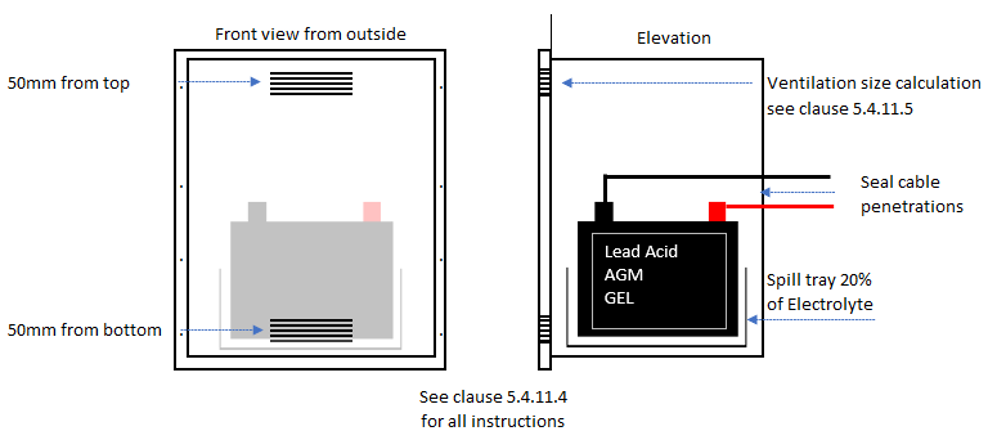
Clause 5.4.11.4 – battery box “sealed insert” fitted to exterior wall. Example only.
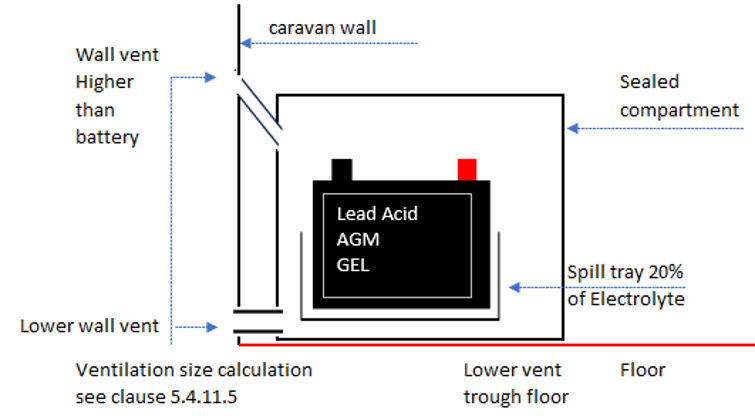
Clause 5.4.11.4 – battery using upper wall vent and lower wall vent. Example only.
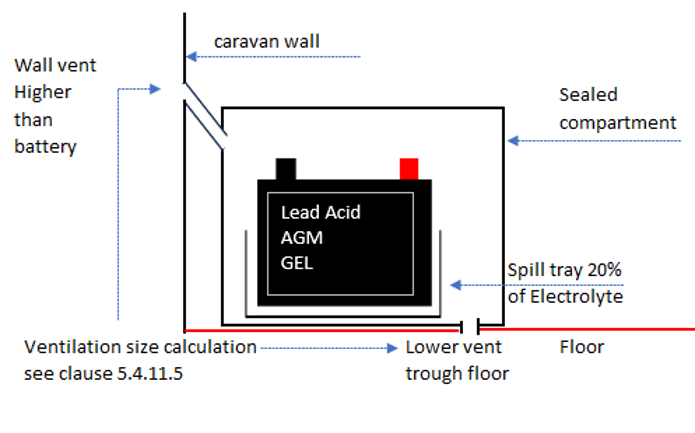
Clause 5.4.11.4 – battery using upper wall vent and lower floor vent. Example only.
It is essential the caravan manufacturer familiarises themselves with the specific requirements of AS/NZS 3001.2 in relation to lithium batteries.
The following guidance material has been developed taking into account recent concerns with lithium battery installations and advice from electrical regulators around how to implement the requirements of the new standard. Refer also to the Lithium Battery Industry Guidance Document (PDF, 339 KB).
The battery compartment design and venting mechanism shall be provided to the installer by the manufacturer and/or supplier of the lithium-ion battery.
Specifications and instructions that should be expected from the battery manufacturer or supplier are:
Additional information that is recommended to be considered is as follows:
Lithium ion batteries shall:
For the purposes of this clause, the term “externally” will be understood to mean the following:
A battery compartment that opens to the exterior should:
If access to the battery compartment is obtained from within the habitable space of the recreational vehicle the compartment must have the following:
Important note: The preceding paragraph, relating to internally accessed battery installations, is not universally accepted by electrical regulators. Some jurisdictions have endorsed this approach, while others do not consider it suitable. It is strongly recommended that you proceed with caution if following this method, considering both the place of manufacture as well as the final destination of your products. Consultation with the relevant state regulator is also strongly recommended.
Note 1: Open to the environment presents a problem if the IP rating is not high enough to protect the battery and/or management system from water ingress, which could be both dangerous and costly.
Note 2: A battery mounted externally, most likely under the vehicle, may be more vulnerable to mechanical damage and even penetration by a foreign object. This would present a very dangerous situation.
Note 3: It is recommended that wherever possible a battery compartment is designed to be accessed from outside the habitable areas of the recreational vehicle.
Note 4: The annex area of a recreational vehicle forms part of the habitable area, so must be considered in relation to battery compartment access and ventilation.
Note 5: It is recommended that a compartment be of a non-combustible material. The compartment should be safely vented to atmosphere, not annex, and all cable penetrations should be fitted with cable glands, bulkhead posts or another form of non-combustible sealing. This is to prevent migration of gasses.
All lithium ion batteries shall comply with AS IEC 62619.
All lithium batteries are required to have a Battery Management System. The BMS is often, usually, part of the battery package and must control cell temperature, voltage, current, charge and cut out points. The clause requires the BMS to provide automatic disconnection for under and over voltage, under and over temperature and over current. Clause 5.4.12.3.3
The standard calls for a monitoring device, specifically designed for managing lithium batteries, to display State of Charge (SoC). The monitoring device may be hard wired or wireless. Clause 5.4.12.3.4
Battery chargers must be compatible with your battery. Confirm with the battery supplier.
Battery manufacturer’s instructions: manufacturer’s instructions will give essential information such as charge and discharge temperature range. This should be supplied in your handover document.
Safety Data Sheets (SDS) are normally available by download. As a “supplier” you must make the SDS available. As lithium is a dangerous substance, it is essential you present your customer with the Safety Data Sheet for the lithium battery supplied. Safety Data Sheets are valid for 5 years and are specific to the product. A “general” Safety Data Sheet for a “similar” battery is not lawful.
The SDS will stipulate first aid measures and firefighting procedures and equipment. Ensure any fire extinguisher recommendation is suitable for the lithium battery supplied.
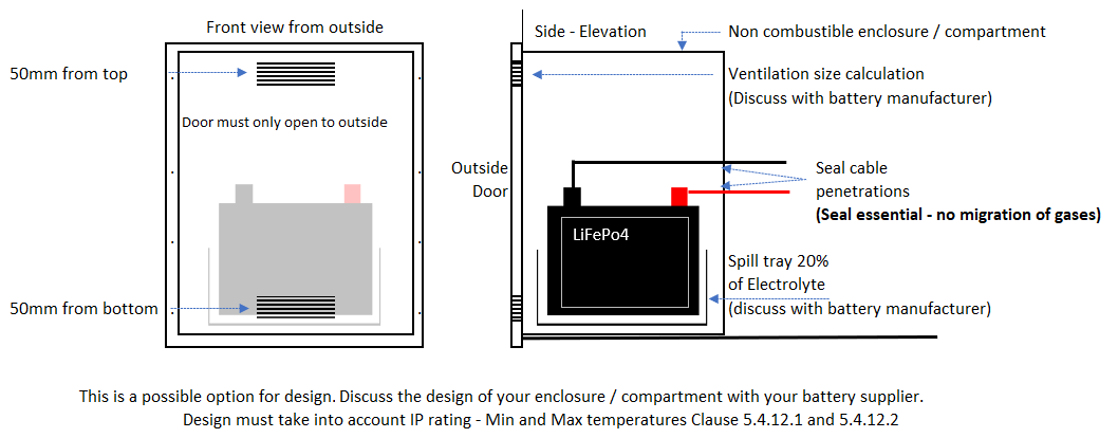
Lithium battery compartment with external access. Example only.
Remember an annex is deemed to be part of the living area and as such ventilation cannot be into an annex.
The final say on interpretation of these clauses rests with the Electrical Safety Regulator in each state or territory jurisdiction. While this information is provided as industry guidance, if there is any uncertainty advice should be sought within your local jurisdiction to confirm any proposed designs.
